
Advanced technologies like multi-omics and single-cell omics in whole genome sequencing reveal cellular heterogeneity with high precision.
Multi-omics and Single-Cell Omics in whole genome sequencing provides researchers or scientists an advanced level of understanding of the biological complexity. It includes the diverse omics layers to our understanding and help to include them in new discoveries. Using these omic layers, scientists can get the full picture of what’s happening inside a cell or tissue to develop new treatments, technologies and discover new pathways mechanisms for better healthcare. These approaches help us analyze and develop personalized medicine, cancer studies, developmental biology. As technology advances, multi-omics and single-cell analysis are redefining the future of genomics and systems biology.
What is Multi-Omics Integration in Genome Sequencing?
We already discussed how advancement in genome sequeencing can lead us to technology advancement, so noe lets discuss what is multiomics or multiple omics integration? Basically it provides an integrated approach to power discovery across multiple levels of biology. It is a term that refers to the process of combining and analyzing data from different omic experimental sources. Let’s start with the basics. The word “omics” in biology refers to the comprehensive study of a particular set of molecules. You might have heard of:
Core Areas of Genome Sequencing & Multi-Omics
- Genomics – the study of DNA
- Transcriptomics – the study of RNA
- Proteomics – the study of proteins
- Metabolomics – the study of small molecules (metabolites)
We need to understand each of these information to combine with multiple omics to fully understand complex biological systems. So, in simple words we can put it this way: it’s like putting together pieces of a puzzle to understand life at the molecular level.
Complete Molecular Picture — What this blog will cover
-
Discover new drug targets
Identify molecular pathways and biomarkers that can be targeted for novel therapies.
-
Understand treatment resistance
Analyze mechanisms behind resistance to existing drugs to improve therapeutic strategies.
-
Design precise, personalized therapies
Leverage molecular profiles to create targeted, patient-specific treatment plans.
In this blog, we are going to walk you through the complete molecular picture, current state of the field, the uses and potential directions for future research. Scroll down to know more.
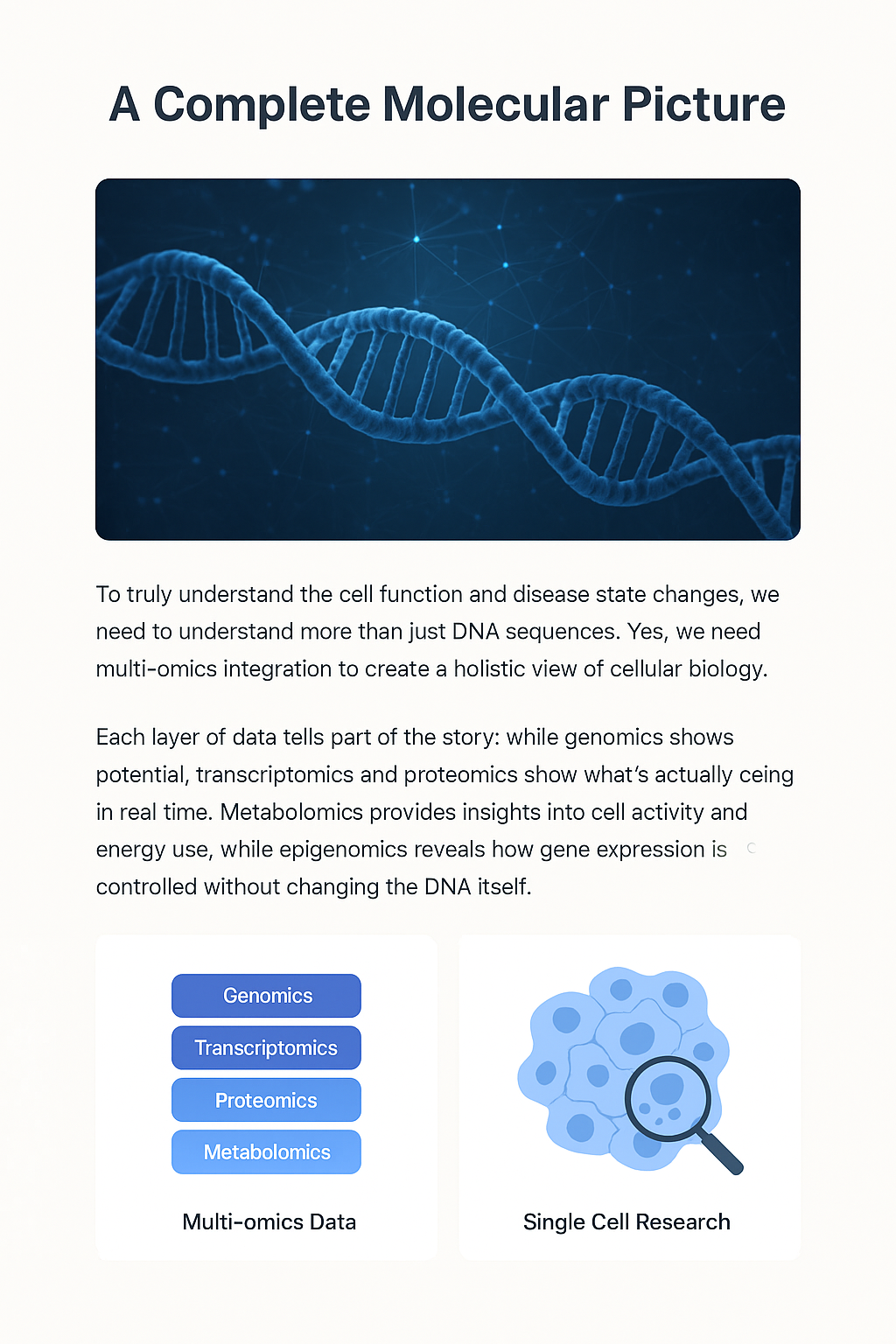
To truly understand the cell function and disease state changes, we need to understand more than just DNA sequences. Yes, we need multi-omics integration to create a holistic view of cellular biology.
Each layer of data tells part of the story: while genomics shows potential, transcriptomics and proteomics show what’s actually happening in real time. Metabolomics provides insights into cell activity and energy use, while epigenomics reveals how gene expression is controlled without changing the DNA itself.

Collection of data at its single-cell level provides powerful insights, which are crucial for understanding complex tissues like tumors. These technologies can pinpoint rare disease-driving cells, monitor drug responses at the cellular level, and even predict treatment resistance. By integrating all these molecular layers, we move closer to decoding life at its most fundamental level — one cell at a time.
What is Single-Cell Omics in Genome Sequencing?
Doing this kind of deep molecular analysis on individual cells is single-cell omics integration. This is not studying a whole tissue including millions of mixed cells, its about looking at each individual cell’s profile, gene expression, and more.
This is powerful because:
- Every cell within the same tissue can behave differently. Learn more about tissue heterogeneity.
- Deadly diseases such as cancer are often found hidden inside a healthy population. Read our guide on early cancer detection.
- Traditional studies may miss these subtle differences. Explore limitations of traditional studies.
- Advanced technologies like single-cell RNA sequencing and single-cell ATAC-seq can explore individual cell functioning and drug response. Check out our single-cell technologies page.
Single-Cell Multimodal Sequencing and its Clinical Insights
So let's discuss the most exciting part of these studies. Single-cell multimodal sequencing combines both single and multiple methods. So it combines multiple types of omics data from the same cell. For example we can measure DNA accessibility, RNA expression and Protein markers from a single cell at once. This helps create a multidimensional molecular profile for individual cell, offering biological insights.
How Multi-Omic Layers Generate Clinical Insights
- Genomics: Multi-omics data from genomics studies like DNA sequencing provide insights into genetic variations across cells. They help us understand genetic mutations.
- Proteomics: Multi-omics data from proteomic studies like protein mechanisms give insights regarding protein dysfunctions and drug targets. They allow us to capture protein expressions.
- Epigenomics: Multi-omics data from epigenomics studies related to gene regulation mechanisms (like methylation) provide insight about protein dysfunctions and drug targets. They show how gene regulation varies across cell populations.
Genome Sequencing – A Hot Area for Personalized Medicine
Without any doubt, we must admit as a clinical research institute, these multilayer advancements are currently a hot area of research. Single-cell multimodal sequencing and multi-omics integration are some of the hottest areas in biomedical research. These studies are widely discussed and extremely popular for understanding and analyzing personalized medicine. Traditional treatments rely on the “one-size-fits-all” model, which doesn’t always work for everyone.
On the other hand, analyzing data from individual cells using multiple biological layers allows scientists and researchers to uncover unique molecular fingerprints. This helps predict treatment responses, leading to customized therapies, fewer side effects from new drugs, and better treatment outcomes. These advancements offer high hope in fields like cardiology, oncology, neurology, and rare genetic disorders. Such techniques introduce precise, effective, and personalized treatments for improved patient outcomes.
Why is this important for Clinical Research?
How Whole Genome Sequencing is Transforming Clinical Research
-
Drug Development and Testing: Pharmaceutical companies are using single-cell and multi-omic approaches to:
- Test drug effects on different subtypes of cells
- Discover new drug targets based on unique molecular signatures
- Anticipate potential side effects
-
Personalized Medicine: Physicians can create treatments specifically tailored to the exact molecular profile of an individual.
For example: Finding types of cancer that do not respond to commonly used drugs or examining in detail how one patient's immune system reacts differently than another's.
- Mapping Complexity of Disease: Many diseases, such as Alzheimer's, autoimmune diseases, and cancers, are incredibly complex. Using single-cell and multi-omic tools, researchers are mapping disease progression in detail and uncovering hidden biological complexity.
- Early Disease Detection: By identifying small molecular changes at the single-cell level, clinicians can detect diseases earlier, sometimes even before symptoms arise.
What You Need to Know About Advanced Technologies in Genome Sequencing
If you are a student, researcher, or doctor following the field of clinical research, bioinformatics, or clinical SAS, here is what you should be paying attention to. First, get a handle on the basic omics fields – start with genomics and transcriptomics. Find your way to some of the basic and advanced bioinformatics tools such as Seurat, Scanpy, and Monocle. These tools may help you analyze single-cell sequencing data effectively.
Moreover, it will be helpful to broaden your understanding of statistics and machine learning, as these are key to analyzing increasingly large and multi-omics datasets. Try to follow relevant real-world case studies, as these tools are being applied extensively in cancer, immunology, and neurology research.
Finally, keep an eye on new tools and technologies in this field. Platforms such as 10x Genomics and Nanopore sequencing are breaking new ground almost every day, providing exciting opportunities for clinical research and personalized medicine.
Final Thoughts
A New Era of Biology in 2025
In 2025, we are starting a new era of biology, which allows us to study life one cell at a time – and this is not limited to one perspective, but many perspectives all at once. Single-cell multimodal sequencing and multi-omics integration are not just buzzwords. They can revolutionize important areas of clinical research, diagnosis, and personalized medicine.
Essentially, the application of these advanced technologies can lead us to new discoveries and more informed ways to provide personalized and effective treatments, leading to new findings for biomarkers and therapeutic targets as per individual patients or subgroups, ultimately extending the boundaries of precision medicine.
Whether you’re a student dreaming of a career in genomics, medicine, or data science, this is one field where your curiosity and skills can truly make a difference.
Want to dive deeper into this topic? At Cliniwave we build careers in bioinformatics. Visit our website today to know more or talk to our advisor. Drop a comment or send your queries—let’s decode biology together!